

| Date | Venue | Fee | |
|---|---|---|---|
| 09 Nov - 13 Nov 2026 | London - UK | $ 5,950 | Register Now |
| 31 May - 04 Jun 2027 | Dubai - UAE | $ 5,950 | Register Now |
About the Course
Industrial automation environments now integrate distributed control systems (DCS), programmable logic controllers (PLC), supervisory control systems, safety instrumented systems (SIS), advanced process control (APC), and industrial communication networks into highly interconnected operational platforms. As production facilities become increasingly digitised, maintaining control stability, functional safety compliance, deterministic communication performance, and cybersecurity integrity has become significantly more demanding. Improper segregation between basic process control and safety functions, inadequate redundancy, poorly tuned advanced control strategies, or network instability can lead to production variability, equipment stress, regulatory exposure, and operational disruption.
The Advanced Certificate in Process Automation training course develops advanced technical capability in control system engineering, functional safety lifecycle coordination, regulatory and multivariable control enhancement, deterministic industrial networking, and system-wide reliability improvement. It incorporates IEC 61511 and IEC 61508 safety lifecycle principles, SIL determination awareness, control performance benchmarking, constraint management strategies, model predictive control (MPC) fundamentals, redundancy validation practices, and cybersecurity risk evaluation aligned with IEC 62443. Delegates will analyse complex control interactions, evaluate safety layer integrity, assess system reliability exposure, and develop structured automation enhancement strategies applicable across the oil & gas, power generation, chemical processing, manufacturing, and utility sectors. Emphasis is placed on disciplined integration, measurable performance improvement, and sustainable automation resilience within high-consequence industrial environments.
Core Objectives
The delegates will achieve the following objectives:
- Analyse integrated control systems across DCS, PLC, supervisory, and SIS platforms
- Evaluate functional safety lifecycle requirements in accordance with IEC 61511 and IEC 61508
- Assess SIL determination principles and safety layer independence validation
- Optimise advanced regulatory and multivariable control strategies
- Design resilient industrial communication systems with redundancy and deterministic performance
- Investigate cybersecurity vulnerabilities within industrial control environments
- Develop structured automation and safety improvement roadmaps aligned with operational reliability objectives
Training Approach
This training course integrates control system configuration review sessions, SIL allocation case discussions, advanced loop performance diagnostics workshops, multivariable interaction analysis exercises, industrial network reliability assessments, and structured safety lifecycle evaluation scenarios. Delegates engage in BPCS–SIS coordination reviews, constraint handling exercises, deterministic communication validation, cybersecurity exposure mapping, and plant-wide performance benchmarking to reinforce technically rigorous automation improvement practices.
The Attendees
This training course is suitable for experienced automation and control professionals responsible for control system integration, functional safety coordination, advanced control optimisation, and automation reliability within complex industrial environments.
A broad range of professionals will benefit, including but not limited to:
- Senior Automation Engineers
- Process Control Engineers
- DCS Engineers
- PLC Engineers
- Instrumentation & Control Engineers
- Functional Safety Engineers
- SIS Engineers
- Industrial Cybersecurity Engineers
- Reliability & Asset Integrity Engineers
- Advanced Process Control (APC) Engineers
- Commissioning & System Integration Engineers
- Technical Operations Authorities
Daily Discussion
DAY ONE: CONTROL SYSTEM ENGINEERING & FUNCTIONAL SAFETY INTEGRATION
- Control Layer Segregation (Basic Control, APC, SIS, Asset Monitoring)
- Redundancy Validation & High-Availability Configuration
- BPCS–SIS Functional Separation & Independence Verification
- IEC 61511 Safety Lifecycle Application
- SIL Determination Awareness & Risk Reduction Concepts
- Safety Instrumented Function (SIF) Integrity & Proof Testing Discipline
DAY TWO: ADVANCED REGULATORY & CONSTRAINT CONTROL
- Two-Degree-of-Freedom PID Configuration
- Cascade, Feedforward, & Override Control Implementation
- Decoupling & Loop Interaction Compensation
- Constraint & Limit Management Techniques
- Gain Scheduling & Nonlinear Process Compensation
- Control Performance Metrics & Variability Assessment
DAY THREE: MULTIVARIABLE CONTROL & OPTIMISATION
- Relative Gain Array (RGA) & Control Pairing Evaluation
- Model Predictive Control (MPC) Structure & Industrial Application
- Constraint Handling & Setpoint Optimisation
- Economic Impact of Advanced Control Deployment
- Real-Time Optimisation vs Regulatory Control
- Performance Monitoring & Variability Reduction Strategy
DAY FOUR: INDUSTRIAL COMMUNICATION & CYBERSECURITY RESILIENCE
- Industrial Ethernet & Fieldbus Determinism
- Network Redundancy Topologies & Failover Validation
- Time Synchronisation & Latency Impact on Control Stability
- IEC 62443 Security Level Awareness
- Network Segmentation & Defence-in-Depth Implementation
- Incident Response & Recovery Planning for Control Systems
DAY FIVE: AUTOMATION RELIABILITY & PERFORMANCE SUSTAINMENT
- Automation System Performance Audit Methodology
- Diagnosing System-Wide Instability & Interaction Risk
- Alarm Rationalisation & Management (ISA 18.2 Awareness)
- Asset Health Integration with Control Performance
- Digital Twin & Data-Driven Optimisation Concepts
- Developing a Structured Automation & Functional Safety Improvement Plan
Certificate Awarded
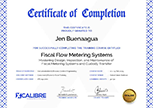
Upon successful completion of this training course, participants will be awarded a Certificate of Completion from XCalibre Training Centre, acknowledging their accomplishment. This certificate serves as a testament to their dedication to developing their skills and advancing their expertise in their respective fields.
Course Enquiry

A XCalibre Professional Development Certification will be given to the delegates upon successful completion of this training course.