
| Date | Venue | Fee | |
|---|---|---|---|
| 27 Apr - 01 May 2026 | Dubai – UAE | $ 5,950 | Register Now |
| 12 Oct - 16 Oct 2026 | Dubai – UAE | $ 5,950 | Register Now |
| 07 Dec - 11 Dec 2026 | London - UK | $ 5,950 | Register Now |
About the Course
Pump stations form the hydraulic backbone of water distribution networks, maintaining pressure stability and flow continuity under variable demand conditions. In real operating environments, stations must respond to fluctuating consumption, wet well level variation, pressure zone interaction, electrical disturbance, telemetry reliability issues, and sensor performance degradation while maintaining energy efficiency. Automated control systems incorporating PLC logic, variable frequency drives (VFDs), pressure transmitters, level instrumentation, and SCADA integration are designed to stabilise operation; however, improper PID tuning, unstable feedback signals, check valve dynamics during shutdown, sequencing conflicts, or communication latency can result in oscillating pressure, excessive cycling, cavitation, reverse flow risk, motor overheating, and increased energy consumption.
This 5-day Pump Station Control & Automation for Water Distribution Networks training course strengthens the technical and operational capability required to diagnose, stabilise, and optimise pump station performance under real distribution constraints. It integrates pump curve–system head interaction, control loop stability analysis, VFD modulation behaviour, redundancy strategies for pressure sensing, telemetry fault detection, and structured automation failure recovery. Delegates evaluate transient response during rapid load change, interpret SCADA trends to identify control instability, isolate sequencing inefficiencies, and apply corrective adjustments that reduce hydraulic stress and improve operational reliability. Emphasis is placed on disciplined troubleshooting, coordination between mechanical and control teams, and sustaining resilient automation performance across distributed and remotely monitored pump stations.
Core Objectives
The delegates will achieve the following objectives:
- Analyse pump curve and system head interaction to determine hydraulic operating limits
- Evaluate PID loop stability and identify oscillation, hunting, overshoot, or lag conditions
- Differentiate mechanical faults, check valve dynamics, and control feedback instability
- Diagnose VFD parameter misconfiguration affecting torque delivery and pressure response
- Assess pressure and level sensor redundancy performance under failure conditions
- Investigate telemetry and SCADA communication faults impacting remote stations
- Implement structured fault isolation and restart procedures following automation or power interruption events
Training Approach
This training course is delivered through structured technical briefings, hydraulic instability case simulations, control loop diagnostics workshops, VFD parameter evaluation exercises, and automation fault isolation mapping based on real distribution pump station conditions. Delegates engage in wet well level instability analysis, restart sequencing simulations following power loss, pressure oscillation troubleshooting, telemetry failure diagnostics, and structured corrective action planning. The methodology reinforces systematic root-cause identification, cross-disciplinary coordination, and resilient control performance under operational stress.
The Attendees
This training course is suitable for technical and operational personnel responsible for pump station performance, control system reliability, automation stability, and pressure regulation within water distribution networks.
A broad range of professionals will benefit, including but not limited to:
- Pump Station Operators
- Senior Pump Station Operators
- Control Room Operators
- Water Distribution Engineers
- SCADA and Automation Engineers
- PLC Technicians
- Electrical Technicians
- Instrumentation Technicians
- Maintenance Supervisors
- Operations and Network Managers
Daily Discussion
DAY ONE: HYDRAULIC BEHAVIOUR, WET WELL DYNAMICS, AND SYSTEM INTERACTION
- Pump Curve and System Head Operating Envelope
- Wet Well Level Fluctuation and Control Instability
- Pressure Zone Interaction and Hydraulic Coupling
- Demand Variability and Hydraulic Response Patterns
- Net Positive Suction Head (NPSH) and Cavitation Indicators
- Check Valve Operation and Reverse Flow Risk
DAY TWO: CONTROL LOOP STABILITY AND SEQUENCING PERFORMANCE
- Lead-Lag Control Architecture in Multi-Pump Stations
- PID Control Loop Components and Tuning Sensitivity
- Loop Hunting, Oscillation, and Overshoot Analysis
- Anti-Cycling Logic and Minimum Runtime Safeguards
- Setpoint Cascade Strategies across Pressure Zones
- Surge Risk during Pump Start, Stop, and Valve Closure
DAY THREE: VARIABLE FREQUENCY DRIVE AND ELECTRICAL CONTROL PERFORMANCE
- VFD Speed-Torque Behaviour under Variable Load
- Ramp Configuration and Hydraulic Stress
- Harmonic Distortion and Motor Thermal Impact
- Power Interruption and Automatic Restart Sequencing
- Protection Parameters, Trips, and Fault Code Interpretation
- Energy Performance Review during Variable Speed Operation
DAY FOUR: AUTOMATION ARCHITECTURE AND FAULT ISOLATION
- PLC Logic Structure and Redundancy Configuration
- Pressure Transmitter Drift and Redundancy Strategy
- Wet Well Level Sensor Failure and Float Malfunction
- Telemetry Reliability in Remote Pump Stations
- Communication Latency between PLC and SCADA
- Manual Override and Safe-State Operation during Automation Loss
DAY FIVE: STABILISATION, RECOVERY, AND PERFORMANCE OPTIMISATION
- Hydraulic Transient Identification in SCADA Records
- Structured Restart after Power Failure or Trip Event
- Pump Performance Deviation and Efficiency Loss Detection
- Coordination between Mechanical and Control Maintenance
- Alarm Rationalisation and Nuisance Reduction
- Continuous Control Performance Improvement Strategy
Certificate Awarded
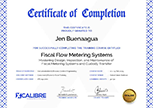
Upon successful completion of this training course, participants will be awarded a Certificate of Completion from XCalibre Training Centre, acknowledging their accomplishment. This certificate serves as a testament to their dedication to developing their skills and advancing their expertise in their respective fields.