
| Date | Venue | Fee | |
|---|---|---|---|
| 16 Nov - 20 Nov 2026 | Dubai – UAE | $ 5,950 | Register Now |
| 26 Apr - 30 Apr 2027 | Dubai - UAE | $ 5,950 | Register Now |
| 05 Jul - 09 Jul 2027 | Dubai – UAE | $ 5,950 | Register Now |
About the Course
Reliable process control depends on stable controller tuning and consistent final control element performance. Across industrial sectors, poorly adjusted PID parameters, unstable feedback signals, valve stiction, actuator mismatch, nonlinear installed characteristics, and signal noise frequently cause oscillation, excessive cycling, slow response, and energy inefficiency. In many facilities, loop instability is incorrectly attributed to controller settings when the root cause lies within the valve assembly, actuator, positioner, or process nonlinearity.
This 5-day Process Controller Tuning & Valves training course strengthens the technical capability required to analyse loop dynamics, apply structured tuning adjustments, and verify valve performance under real operating conditions. It integrates closed-loop response evaluation, process gain and dead-time awareness, stability margin recognition, cascade interaction behaviour, installed valve characteristic assessment, actuator response validation, and systematic fault isolation. Delegates will interpret trend data, perform controlled step testing, identify stiction and travel deviation patterns, assess valve authority, and distinguish tuning limitations from mechanical constraints. Emphasis is placed on practical tuning discipline, travel-based valve diagnostics, control performance KPIs, and coordination between operations and maintenance teams. It assumes prior familiarity with PID fundamentals and focuses on improving loop robustness, reducing variability, and enhancing final control element reliability without reliance on advanced mathematical derivations.
Core Objectives
The delegates will achieve the following objectives:
- Interpret loop response behaviour to determine stability margins and process variability
- Examine proportional and integral sensitivity relative to process gain and dead time
- Recognise nonlinear process behaviour affecting controller effectiveness
- Distinguish tuning instability from valve stiction, hysteresis, or actuator delay
- Appraise installed valve authority and its influence on loop performance
- Detect positioner calibration drift and travel deviation trends
- Apply structured loop performance audit methods to sustain stable and efficient control
Training Approach
This training course combines guided loop-response interpretation, supervised controller adjustment exercises, valve travel analysis sessions, and structured fault-isolation simulations based on real industrial control scenarios. Delegates work through oscillation diagnosis, gain sensitivity testing, dead-time estimation, and valve performance verification tasks using realistic process trends and disturbance cases. Emphasis is placed on disciplined parameter adjustment, evidence-based troubleshooting, and systematic differentiation between controller limitations and mechanical valve constraints. The approach reinforces repeatable tuning practices, practical field validation techniques, and coordinated problem resolution between operations, instrumentation, and maintenance teams.
The Attendees
This training course is designed for technical and operational personnel responsible for control loop stability, PID tuning, and final control element performance within industrial process environments.
A broad range of professionals will benefit, including but not limited to:
- Process Control Engineers
- Instrumentation and Control Engineers
- Automation Engineers
- Control Room Engineers and Operators
- Instrument Technicians
- Maintenance Engineers
- Reliability Engineers
- Process Engineers
- Operations Supervisors
Daily Discussion
DAY ONE: LOOP DYNAMICS AND PERFORMANCE ASSESSMENT
- Closed-Loop Response and Process Gain Interpretation
- Dead Time, Time Constant, and Stability Margin Awareness
- Identifying Oscillation, Overshoot, and Slow Recovery
- Load Disturbance versus Setpoint Change Behaviour
- Trend-Based Loop Performance Indicators
- Interaction between Controller Output and Valve Travel
- Control Performance KPIs (IAE, Settling Time, Variability Index)
DAY TWO: STRUCTURED AND REPEATABLE CONTROLLER TUNING
- Step-Response Testing in Operating Systems
- Proportional and Integral Sensitivity Mapping
- Dead-Time Impact on Tuning Effectiveness
- Integral Windup Recognition and Reset Limiting
- Tuning under Measurement Noise and Filtering
- Cascade Loop Interaction Awareness
- Validation and Documentation of Tuning Adjustments
DAY THREE: VALVE ENGINEERING AND INSTALLED BEHAVIOUR
- Valve Cv Review and Installed Performance Considerations
- Valve Authority and Pressure Drop Distribution
- Linear vs Equal Percentage Characteristics
- Actuator Sizing and Torque Capability
- Positioner Operation and Feedback Verification
- Process Nonlinearity and Installed Gain Variation
- Travel-Based Performance Monitoring
DAY FOUR: FIELD VALVE TROUBLESHOOTING AND MECHANICAL DIAGNOSTICS
- Identifying Stiction and Stick-Slip Behaviour
- Detecting Hysteresis and Deadband
- Travel Deviation and Signal Feedback Mismatch
- Diagnosing Seat Leakage and Internal Wear
- Instrument Air Quality and Actuator Response Delay
- Packing Friction and Mechanical Binding
- Structured Isolation between Controller and Valve Fault
DAY FIVE: INTEGRATED LOOP OPTIMISATION AND SUSTAINABILITY
- Coordinating Tuning Adjustments with Valve Constraints
- Reducing Excessive Output Movement and Cycling
- Minimising Energy Loss from Poor Modulation
- Monitoring Long-Term Loop Stability
- Loop Performance Audit Methodology
- Developing Preventive Valve Maintenance Indicators
- Establishing a Sustainable Control Performance Improvement Plan
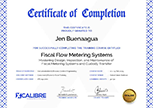
Certificate Awarded
Upon successful completion of this training course, participants will be awarded a Certificate of Completion from XCalibre Training Centre, acknowledging their accomplishment. This certificate serves as a testament to their dedication to developing their skills and advancing their expertise in their respective fields.