
| Date | Venue | Fee | |
|---|---|---|---|
| 12 Apr - 16 Apr 2027 | Dubai - UAE | $ 5,950 | Register Now |
| 31 May - 04 Jun 2027 | Dubai - UAE | $ 5,950 | Register Now |
| 18 Oct - 22 Oct 2027 | Dubai – UAE | $ 5,950 | Register Now |
About the Course
Reliable measurement and effective process control are fundamental to safe, stable, and efficient plant operations across oil & gas, petrochemical, power, and manufacturing facilities. As process systems become more integrated and performance expectations increase, the integrity of instrumentation and control loops has direct impact on safety, product quality, energy consumption, and asset reliability. Inaccurate measurements, poorly tuned loops, undocumented modifications, or inadequate maintenance practices can lead to instability, unplanned shutdowns, regulatory exposure, and financial loss. International standards such as ISA, IEC, and API provide structured guidance for instrument specification, alarm management, control valve performance, lifecycle discipline, and cybersecurity resilience, forming the technical foundation for defensible engineering practice.
This 5-day Process Measurement, Instrumentation & Process Control training course is designed to strengthen professional competence in measurement assurance, loop stability, and control performance improvement within multi-industry environments. It reinforces alignment with recognised standards including ISA 5.1, ISA 18.2, IEC 60534, IEC 61511, IEC 62443, and ISO 17025, enabling delegates to evaluate instrumentation integrity and control effectiveness with greater technical confidence. Delegates enhance their ability to interpret specifications, assess reliability risks, diagnose loop instability, and support optimisation initiatives while maintaining compliance discipline. Through structured technical discussion and applied analysis, it equips engineers and technical authorities to strengthen operational performance, reduce variability, and sustain long-term process reliability.
Core Objectives
The delegates will achieve the following objectives:
- Evaluate measurement system integrity against ISA and IEC performance principles
- Interpret instrument specifications, calibration data, and compliance documentation in accordance with recognised standards
- Analyse process dynamics and control loop behaviour to identify sources of instability or performance degradation
- Apply advanced PID tuning and control strategy principles to improve loop responsiveness and disturbance rejection
- Assess control valve performance and actuator behaviour using IEC-based criteria
- Formulate reliability and optimisation actions that enhance measurement accuracy, control stability, and energy efficiency
- Validate instrumentation and control practices against industry-recognised lifecycle and governance expectations
Training Approach
This training course is delivered through structured technical facilitation, applied engineering discussions, and analysis of real operating scenarios aligned with ISA and IEC guidance. Delegates engage in collaborative problem-solving exercises to interpret data, evaluate loop behaviour, and strengthen practical decision-making in measurement and control performance improvement.
The Attendees
This training course is suitable for engineering professionals and technical authorities responsible for the specification, performance, reliability, and optimisation of measurement and control systems within industrial processing facilities.
A broad range of professionals will benefit, including but not limited to:
- Instrumentation and Control Engineers
- Process Control Engineers
- Automation and DCS Engineers
- PLC and Control System Engineers
- Electrical and Instrumentation Engineers
- Maintenance and Reliability Engineers
- Commissioning and Start-Up Engineers
- Technical Authorities and Engineering Supervisors
- Plant Performance and Optimisation Engineers
- Operations and Process Engineers involved in control loop management
Daily Discussion
DAY ONE: MEASUREMENT & SIGNAL FUNDAMENTALS
- Measurement Accuracy and Uncertainty
- Pressure, Flow, Level, and Temperature Technologies
- Sensor Selection and Process Suitability
- Signal Transmission and Communication Standards
- Installation Errors and Signal Distortion
- Measurement Impact on Control Stability
DAY TWO: INSTRUMENT SPECIFICATION & RELIABILITY
- Instrument Specification and Datasheets
- Calibration Principles and Traceability
- Failure Modes and Degradation Patterns
- Environmental Effects on Instruments
- Maintenance and Lifecycle Planning
- Documentation and Compliance Discipline
DAY THREE: CONTROL LOOP FUNDAMENTALS
- Open-loop and Closed-loop Control
- PID Structure and Tuning
- Process Dynamics and Response Behaviour
- Stability and Performance Indicators
- Control Valve Behaviour and Response
- Loop Performance Evaluation
DAY FOUR: ADVANCED CONTROL & INTEGRATION
- Cascade, Ratio, and Feedforward Control
- Disturbance Rejection Principles
- DCS Architecture and Signal Mapping
- PLC Interfacing Considerations
- Alarm Management Fundamentals
- Control System Cybersecurity Awareness
DAY FIVE: OPTIMISATION & PERFORMANCE IMPROVEMENT
- Loop Performance Benchmarking
- Root Cause Analysis of Instability
- Instrument Drift and Correction
- Energy Optimisation through Control
- Reliability Improvement Strategies
- Continuous Monitoring Practices
Certificate Awarded
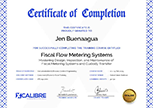
Upon successful completion of this training course, participants will be awarded a Certificate of Completion from XCalibre Training Centre, acknowledging their accomplishment. This certificate serves as a testament to their dedication to developing their skills and advancing their expertise in their respective fields.