
| Date | Venue | Fee | |
|---|---|---|---|
| 01 Jun - 05 Jun 2026 | London - UK | $ 5,950 | Register Now |
| 03 Aug - 07 Aug 2026 | Dubai – UAE | $ 5,950 | Register Now |
| 05 Oct - 09 Oct 2026 | Rome - Italy | $ 5,950 | Register Now |
| 09 Nov - 13 Nov 2026 | Kuala Lumpur - Malaysia | $ 5,950 | Register Now |
| 30 Nov - 04 Dec 2026 | Dubai – UAE | $ 5,950 | Register Now |
| 28 Dec - 01 Jan 2027 | London - UK | $ 5,950 | Register Now |
| 22 Mar - 26 Mar 2027 | Dubai – UAE | $ 5,950 | Register Now |
| 31 May - 04 Jun 2027 | London - UK | $ 6,950 | Register Now |
| 02 Aug - 06 Aug 2027 | Dubai – UAE | $ 5,950 | Register Now |
| 04 Oct - 08 Oct 2027 | Rome - Italy | $ 6,950 | Register Now |
| 08 Nov - 12 Nov 2027 | Kuala Lumpur - Malaysia | $ 6,950 | Register Now |
| 29 Nov - 03 Dec 2027 | Dubai – UAE | $ 5,950 | Register Now |
| 27 Dec - 31 Dec 2027 | London - UK | $ 6,950 | Register Now |
About the Course
Accurate custody transfer, reliable storage systems, and effective loss control are essential to maintaining revenue integrity and operational transparency across crude oil operations. Measurement errors, transfer imbalances, and undetected losses can lead to financial discrepancies, contractual disputes, and compliance exposure across terminals, pipelines, and production facilities. These challenges are further intensified by multi-party transfer interfaces, variations in crude properties, and the need for consistent measurement and reporting across interconnected systems. A structured and standards-driven approach is therefore required to ensure accuracy, traceability, and control throughout custody transfer and storage activities. Industry frameworks such as the American Petroleum Institute API MPMS, alongside ISO and OIML standards, define the requirements for measurement, calibration, and verification to ensure reliable and repeatable results.
This 5-day Crude Oil Custody Transfer, Storage, and Loss Control training course equips delegates with the capability to manage measurement systems, control transfer interfaces, maintain inventory integrity, and minimise losses across crude oil facilities. It focuses on measurement assurance, transfer execution, storage management, reconciliation systems, and loss control aligned with current industry practices. Delegates will enhance their ability to ensure transfer accuracy, detect discrepancies, and manage financial exposure effectively. Emphasis is placed on integrating measurement, operations, and hydrocarbon accounting processes to support accurate reporting, strengthen control, and ensure consistent revenue assurance across operational environments.
Core Objectives
By the end of the training course, delegates will be able to:
- Interpret custody transfer systems and API MPMS requirements
- Execute transfer operations across pipeline, marine, and terminal interfaces
- Administer inventory measurement and stock control practices
- Validate measurement accuracy through proving and calibration processes
- Quantify reconciliation variances and financial discrepancies
- Optimise storage performance and tank utilisation
- Eliminate losses across transfer and storage systems
Training Approach
This training course delivers a structured and calculation-driven learning experience through expert-led instruction, real transfer scenarios, and applied exercises aligned with custody transfer, storage, and hydrocarbon accounting environments.
The Attendees
This training course is designed for professionals responsible for custody transfer, storage operations, and hydrocarbon accounting across oil & gas facilities.
A broad range of professionals will benefit, including but not limited to:
- Measurement Engineers
- Terminal Operators
- Tank Farm Operators
- Production Engineers
- Hydrocarbon Accounting Professionals
- Operations Engineers
- Finance and Commercial Analysts
Daily Discussion
DAY ONE: CUSTODY TRANSFER MEASUREMENT SYSTEMS AND STANDARDS (API MPMS)
- Custody Transfer Principles and Financial Accountability
- Flow Measurement Technologies and Selection Criteria
- Metering System Configuration and Instrumentation
- Application of API MPMS Standards (Volumes, Proving, Corrections)
- Measurement Data Acquisition and System Integration
DAY TWO: TRANSFER EXECUTION AND INTERFACE CONTROL
- Pipeline, Marine, and Terminal Transfer Coordination
- Line Filling, Displacement, and Interface Management
- Pump Operation and Flow Control During Transfer
- Sampling, Quality Verification, and Interface Detection
- Transfer Documentation, Ticketing, and Handover Protocols
DAY THREE: STORAGE SYSTEMS AND INVENTORY CONTROL
- Tank Systems, Configurations, and Storage Operations
- Tank Gauging, Volume Determination, and Corrections (CTL/CTPL)
- Temperature, Density, and API Gravity Adjustments
- Inventory Monitoring and Stock Control Systems
- Integration of Storage Data with Measurement Systems
DAY FOUR: RECONCILIATION AND SYSTEM BALANCING
- Mass Balance and Reconciliation Methodologies
- Identification of Transfer and Inventory Variances
- Data Validation Across Measurement, Transfer, and Storage Systems
- Handling Discrepancies and Adjustment Procedures
- System Integration for End-to-End Data Consistency
DAY FIVE: LOSS IDENTIFICATION, QUANTIFICATION, AND CONTROL
- Classification of Losses (Operational and Unaccounted)
- Detection of Losses Across Transfer and Storage Systems
- Root Cause Analysis of Loss Events and Variances
- Loss Reduction and Prevention Strategies
- Monitoring, Reporting, and Financial Impact of Losses
Certificate Awarded
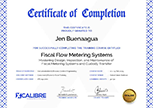
Upon successful completion of this training course, participants will be awarded a Certificate of Completion from XCalibre Training Centre, acknowledging their accomplishment. This certificate serves as a testament to their dedication to developing their skills and advancing their expertise in their respective fields.