
| Date | Venue | Fee | |
|---|---|---|---|
| 30 Nov - 04 Dec 2026 | Dubai – UAE | $ 5,950 | Register Now |
| 05 Apr - 09 Apr 2027 | Dubai – UAE | $ 5,950 | Register Now |
| 12 Jul - 16 Jul 2027 | Dubai – UAE | $ 5,950 | Register Now |
| 20 Sep - 24 Sep 2027 | London - UK | $ 6,950 | Register Now |
| 29 Nov - 03 Dec 2027 | Virtual/Live | $ 5,950 | Register Now |
About the Course
Every sound investment decision depends on reliable financial analysis. Whether assessing a company's performance, valuing a business, selecting securities or allocating capital across asset classes, decision-makers need a clear understanding of profitability, cash generation, risk and value. Shifting interest rates, inflationary pressures, geopolitical shocks and the growth of alternative and sustainable investments have made markets more complex, increasing the risk of mispriced assets, poor capital allocation and returns that fail to compensate investors for the risks they assume. Corporate treasuries, banks, asset managers and institutional investors therefore need professionals who can combine analytical rigour with disciplined investment processes and sound governance.
This 5-day Financial Analysis & Investment Management training course combines rigorous financial statement analysis with advanced investment management techniques. It covers ratio, cash flow and earnings quality analysis, business valuation using discounted cash flow and relative valuation methods, the risk and return characteristics of equities, fixed income and alternative investments, and portfolio construction based on modern portfolio theory, the Capital Asset Pricing Model and asset allocation principles. Delegates will also examine risk measures such as Value at Risk, risk-adjusted performance evaluation, performance attribution, ESG integration and investment governance, with reference to the Global Investment Performance Standards (GIPS). It enables delegates to make well-supported investment recommendations, strengthen portfolio decisions and report investment performance with clarity and credibility.
Core Objectives
The delegates will achieve the following objectives:
- Analyse financial statements to evaluate profitability, liquidity, solvency and efficiency
- Assess cash flow quality and detect accounting red flags in reported results
- Value companies using discounted cash flow, relative valuation and income-based models
- Compare the risk and return characteristics of equities, fixed income and alternative investments
- Construct diversified portfolios using modern portfolio theory and asset allocation principles
- Measure portfolio risk using volatility, Value at Risk and drawdown metrics
- Evaluate investment performance using risk-adjusted measures and performance attribution
Training Approach
This training course combines expert-led presentations with practical exercises in financial statement analysis, valuation modelling, investment risk assessment and portfolio construction. Delegates analyse published financial statements, build valuation models, calculate risk and return measures, and construct and rebalance portfolios using spreadsheet tools and relevant market data. Case analysis, investment committee simulations and facilitated discussions enable delegates to test their judgement, defend their recommendations and exchange professional insights across corporate, banking and asset management environments.
The Attendees
This training course is designed for finance and investment professionals responsible for or involved in analysing companies, evaluating investment opportunities and managing portfolios or treasury assets.
A broad range of professionals will benefit, including but not limited to:
- Chief Financial Officers
- Finance Directors
- Investment and Portfolio Managers
- Financial and Equity Research Analysts
- Treasury Managers
- Corporate Finance and M&A Professionals
- Wealth Managers and Private Bankers
- Risk Managers
- Pension and Endowment Fund Officers
- Investment Committee Members
Daily Discussion
DAY ONE: FINANCIAL STATEMENT ANALYSIS
- Financial Statement Interpretation and Analytical Review
- Common-Size and Trend Analysis
- Profitability, Liquidity, Solvency and Efficiency Ratios
- DuPont Analysis and Return on Equity Drivers
- Cash Flow Analysis and Free Cash Flow Assessment
- Quality of Earnings and Accounting Red Flags
DAY TWO: BUSINESS VALUATION METHODS
- Business Valuation Approaches and Value Drivers
- Cost of Equity, Cost of Debt and WACC
- Discounted Cash Flow Valuation
- Relative Valuation Using Multiples
- Dividend Discount and Residual Income Models
- Valuation of Mergers, Acquisitions and Private Companies
DAY THREE: INVESTMENT ANALYSIS ACROSS ASSET CLASSES
- Investment Process and Investment Policy Statement
- Investment Risk-Return Assessment
- Equity Investment Analysis
- Bond Pricing, Yield and Duration
- Alternative Investments: Real Estate, Private Equity and Commodities
- ESG Integration in Investment Analysis
DAY FOUR: PORTFOLIO CONSTRUCTION AND RISK MANAGEMENT
- Modern Portfolio Theory and Diversification
- Efficient Frontier Analysis and Portfolio Optimisation
- CAPM, Beta and Multi-Factor Models
- Strategic and Tactical Asset Allocation
- Volatility, Value at Risk and Drawdown Measures
- Portfolio Risk Hedging with Derivatives
DAY FIVE: PERFORMANCE EVALUATION AND INVESTMENT GOVERNANCE
- Time-Weighted and Money-Weighted Return Analysis
- Sharpe, Treynor, Jensen's Alpha and Information Ratio
- Performance Attribution and Benchmarking
- Global Investment Performance Standards (GIPS)
- Behavioural Finance and Investor Biases
- Investment Governance and Stakeholder Reporting
Certificate Awarded
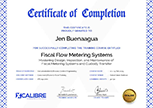
Upon successful completion of this training course, participants will be awarded a Certificate of Completion from XCalibre Training Centre, acknowledging their accomplishment. This certificate serves as a testament to their dedication to developing their skills and advancing their expertise in their respective fields.