| Date | Venue | Fee | |
|---|---|---|---|
| 20 Jul - 24 Jul 2026 | London - UK | $ 5,950 | Register Now |
| 21 Sep - 25 Sep 2026 | Dubai – UAE | $ 5,950 | Register Now |
| 16 Nov - 20 Nov 2026 | Barcelona - Spain | $ 5,950 | Register Now |
About the Course
Aboveground welded storage tanks remain critical containment assets in oil, gas, petrochemical, and energy facilities, where structural integrity, weld quality, foundation performance, and corrosion protection directly influence operational safety and environmental compliance. With aging tank inventories, increased regulatory scrutiny, and heightened environmental accountability, strict adherence to API 620 and API 650 design and construction requirements have become more important than ever. API 651 further provides structured guidance for cathodic protection systems essential to mitigating corrosion and extending service life in increasingly demanding operating environments.
In parallel with evolving industry expectations, tank construction and inspection practices now emphasise quality traceability, improved documentation control, enhanced inspection technologies, and defensible engineering decisions. Misinterpretation of code provisions, fabrication tolerances, erection controls, or corrosion protection measures can lead to structural instability, leakage, costly rework, and significant operational risk. This 5-day API 620/650/651: Design, Fabrication, Erection, and Inspection of Welded and Large Low-Pressure Welded Storage Tanks and Their Cathodic Protection training course develops practical and engineering-level understanding of tank design principles, fabrication controls, erection practices, inspection acceptance criteria, and cathodic protection implementation. Delegates will strengthen their ability to interpret API clauses, evaluate compliance documentation, and support technically sound decisions throughout the tank lifecycle.
Core Objectives
The delegates will achieve the following objectives:
- Apply API 620 and API 650 requirements to review and validate storage tank design decisions
- Evaluate fabrication, welding, and erection practices to ensure compliance with current API tolerances and quality documentation requirements
- Interpret inspection findings and non-destructive examination results in accordance with API acceptance criteria
- Assess structural and corrosion risks to support informed engineering and operational decisions
- Implement API 651 cathodic protection principles to enhance long-term tank integrity
- Strengthen compliance oversight across design, construction, and commissioning phases
- Support defensible technical decisions in storage tank engineering projects
Training Approach
This training course integrates structured API code interpretation with applied design reviews, fabrication case discussions, and cathodic protection evaluation exercises. Delegates analyse real tank construction and corrosion scenarios to strengthen compliance judgement, documentation review capability, and defensible technical decision-making.
The Attendees
This training course is suitable for professionals involved in the design, fabrication, erection, inspection, and corrosion protection of aboveground storage tanks.
A broad range of professionals will benefit, including but not limited to:
- Mechanical Engineers
- Tank Farm Supervisors
- Project Engineers
- Integrity & Compliance Engineers
- Terminal Operations Engineers
- Civil and Structural Engineers
- Tank Design Engineers
- QA/QC Engineers
- Welding Engineers
- Construction and Erection Supervisors
- Inspection Engineers
- Corrosion and Cathodic Protection Engineers
- Technical Authorities and Engineering Managers
Daily Discussion
DAY ONE: MODERN TANK DESIGN & STRUCTURAL INTEGRITY (API 620 & 650)
- Code Scope, Applicability, and Recent Revision Considerations
- Design Pressure, Temperature, and Load Combinations
- Shell Thickness Determination and Wind/Seismic Loading
- Roof Configurations: Fixed Roof and Floating Roof Systems
- Bottom Settlement Allowance and Edge Stress Evaluation
- Foundation Interface, Soil Interaction, and Settlement Monitoring Trends
DAY TWO: FABRICATION, WELDING & QUALITY TRACEABILITY
- Material Selection and Updated Allowable Stress Interpretation
- Plate Forming Tolerances and Dimensional Control Technologies
- Welding Procedure Qualification and Documentation Control
- Digital Weld Mapping and Traceability Practices
- Heat Treatment Provisions (API 620 Focus)
- Quality Documentation, MDR Compilation, and Audit Readiness
DAY THREE: ERECTION CONTROL & CONSTRUCTION RISK MANAGEMENT
- Tank Erection Sequencing and Structural Alignment Control
- Plumbness, roundness, and dimensional verification methods
- Floating roof installation risk considerations
- Hydrostatic testing risk management and acceptance
- Field inspection checkpoints and compliance verification
- Construction interface management and safety-critical controls
DAY FOUR: INSPECTION TECHNOLOGIES & COMPLIANCE ASSURANCE
- Visual Inspection and NDE Acceptance Criteria
- Radiographic, Ultrasonic, and Advanced Phased-Array Awareness
- Weld Defect Evaluation and Repair Decision Criteria
- Dimensional Verification and Settlement Assessment
- Documentation Review and Compliance Audit Preparation
- Failure Case Insights and Lessons Learned
DAY FIVE: CATHODIC PROTECTION & MODERN CORROSION MANAGEMENT (API 651)
- Corrosion Mechanisms Affecting Aboveground Storage Tanks
- Bottom Plate Corrosion and Soil-Side Degradation Risks
- Impressed Current and Sacrificial Anode System Design
- CP Monitoring Technologies and Remote Monitoring Trends
- CP Testing, Rectifier Control, and Performance Verification
- Integration of CP with Long-term Integrity Management Strategy
Certificate Awarded
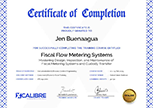
Upon successful completion of this training course, participants will be awarded a Certificate of Completion from XCalibre Training Centre, acknowledging their accomplishment. This certificate serves as a testament to their dedication to developing their skills and advancing their expertise in their respective fields.